
Our curriculum promotes a love of lifelong learning by eliciting in students a sense of awe and wonder. It develops student reasoning and promotes depth of understanding; seeks to enrich student opportunities and readies them for the world of work.
For more information about our Curriculum, please contact Mr Turner (Assistant Headteacher – Curriculum & Assessment) [email protected]

Our curriculum does not begin and end at classroom doors. The curriculum identifies opportunities to develop the whole student, as well as promoting attributes we believe are crucial to enjoying lifelong happiness, success, and citizenship.
Our arena way – teaching and learning framework
Every lesson will follow our teaching and learning framework detailed below.
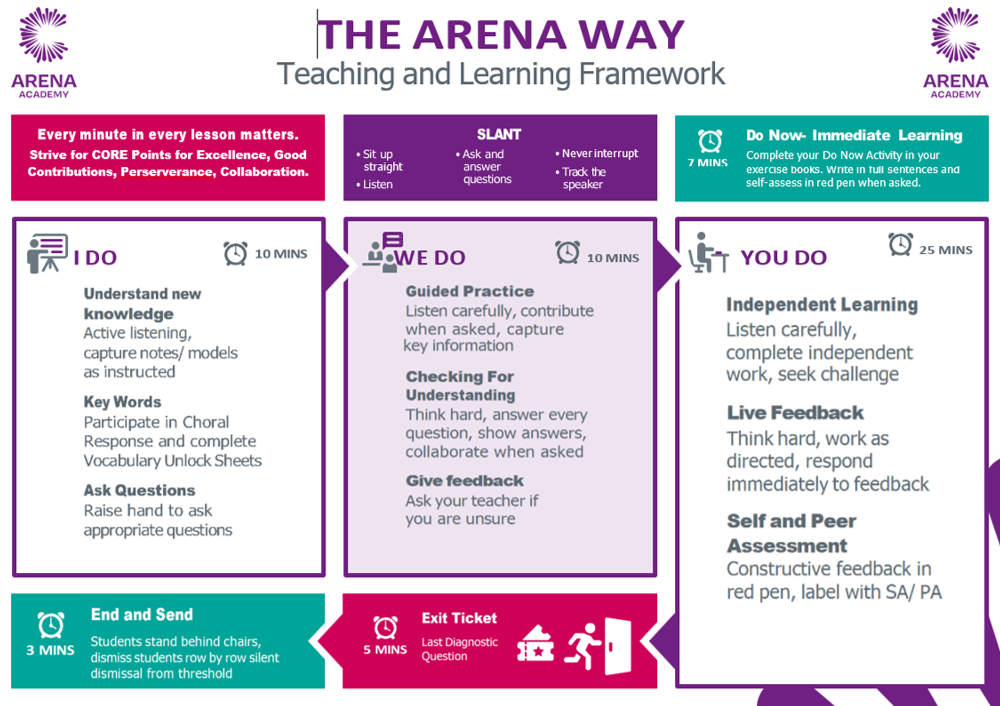
Fundamentally, we believe that great teaching is about good relationships, with a classroom culture rooted in mutual respect and trust. We also don’t believe in gimmicks – our approach to teaching is based on the most reliable research.
Research on human cognitive architecture over the last 30 years has tentatively begun to unpick how we learn the things that we have not evolved to pick up easily. We want students to be able to expand their practically limitless long-term memory, to then be best placed to use their working memory to solve problems they will face in and out of school.
A mixture of well thought out teacher led explanations, modelling of processes and techniques, coupled with targeted questioning, guides students through complex, challenging topics. Followed by lots of deliberate practice, both guided and independently, with regular feedback from the teacher, this is what constitutes the most effective way to acquire new skills and knowledge.
Our aim is for students to know more, remember more and do more.
The implementation of reading strategies taking place at Arena Academy.
Learning to Read
- Reading Age Test
- Key Stage Three: Reading Plus
- Teaching Reading & Fluency
- Ruth Miskin Phonics
- Lexia PowerUp & Fresh Start
- PIXL Vocabulary Unlock
- NGRT Tests
- English PASS Tests
Annual reading age testing of all students – data shared with staff. Key Stage 3 students tracked on the Reading Plus program. This is completed as homework and in lesson one hour a week. In Form Time, students complete literacy tasks where data of student’ fluency is observed and practiced. Ruth Miskin phonics and Lexia PowerUp and Fresh Start interventions for targeted students are used as specialist intervention. NGRT tests are completed by students alongside their English PASS tests to assess their skills in shared with staff.
Reading to Learn
- Academic Texts
- Curriculum Design
- Guided Reading Time
- Targeting Vocabulary: Tier 2/3
- Classroom Word Walls
- Vocabulary Unlock
- Reading Waves
All students engage with Guided Reading Time at the start of every Period 5. Each faculty has outlined how reading links to their subject and learning. Staff CPD has been undertaken in this. Academic texts are chosen to meet the curriculum requirements. Vocabulary Unlock sheets are used when learning new terminology. Reading Waves program is used in combination with Class Charts to allow staff to use reading data within lessons to target students.
Reading beyond the Classroom
- Literary Tales
- Guided Reading Time
- Staff Reading Recommendation
- Book of the Month
- Arena Library
- Reading Club
- Literary Competitions
All students complete Form Time Reading each week where pupils read together as a class. These texts have been chosen to promote a love of reading beyond the classroom and curriculum. Each staff member has identified their favourite book and what they are currently reading on their classroom doors. Students are provided with a recommended book each month. Subjects offer pre-reading activities as homework. The Arena Library also promotes a reading club. Students have also taken part in an assortment of projects like the Creative Writing club and poetry competitions.
Reading for Pleasure
- The Library
- Events and Experiences
- Bookmarked
- Priestley Smith and Beeches
- Primary Projects
The library is the centre of reading for pleasure with recommendations and “Bookflix” promoted on the screens around school. Students have taken part in events such as World Book Day and National Storytelling. Students have also taken part in other projects like the Priestley Smith and Beeches Primary reading projects where Year 9 and 10 students read to other pupils in our campus site. Students have performed their own work in front of others as part of their year group assemblies.
Supporting a knowledge-rich curriculum
Knowledge organisers help children to learn and retain the knowledge of our curriculum. They are only effective at helping children to learn and remember more when they are built on a knowledge-rich curriculum, sequencing knowledge over time that links to children’s previous and later learning across the whole school.
- Learn
Choose a small ‘chunk’ of your the page to learn. Read it over and over again in your head.
- Cover
Cover up the information you have just learnt.
- Write
When the knowledge is covered up, write down the information you studied.
- Correct
Correct your answer, write any missing or incorrect words in red pen.
What are the benefits?
The main benefit of using knowledge organisers is that they give children and teachers the ‘bigger picture’ of a topic, subject area or specific concept. Some topics can be complicated, so having the essential knowledge, clear diagrams, explanations and key terms on one document can be beneficial.
Research shows that our brains remember things more efficiently when we know the ‘bigger picture’ and can see how chunks of knowledge within that subject area link, forming powerful schemas. Making links helps information move into our long-term memory. The more you know, the more you learn, which helps children gain a deeper understanding over time.
Another key benefit is their use for retrieval practice. Regular retrieval of knowledge helps us remember more effectively, as Roediger and Butler explore in their article ‘The critical role of retrieval practice in long-term retention’, featured in Trends in Cognitive Science. Again, it helps us store and recall knowledge from the long-term memory and frees up space in the working memory to take on new knowledge (Hirsch, Why Knowledge Matters, 2016).
The other benefit is that they make the knowledge explicit. So, even if a child misses a lesson, they have a constant point of reference. They give a class a ‘level playing field’ of knowledge, with more children having a general awareness and set of knowledge about a topic.
Summary
- Knowledge organisers are a key part of helping children know and remember more.
- Students are able to memorise key knowledge, or have that key knowledge at their fingertips, therefore reducing cognitive load when working on complex tasks.
- Enables them to be more critical in their thinking about that topic.
- Provide students with summary notes for reference.
- knowledge organisers offer an excellent way to help fill pre-existing knowledge gaps.
Our assessment model is designed to support students in knowing more, remembering more and doing more over time. Assessment is carefully planned across the academic year through progress checks, formal examinations, mock examinations and external examinations, providing regular opportunities to monitor achievement and identify next steps in learning. Parents and carers are kept informed through scheduled progress reporting and parents’ evenings.
At Key Stage 3, assessment is curriculum-led and focused on students’ developing knowledge, understanding and skills rather than simply grades. Subject-specific assessment grids help students understand what success looks like at different stages of their learning journey and provide clear criteria linked directly to the taught curriculum. This approach enables staff to identify strengths, address gaps in learning and ensure every student is supported to make strong progress across all subjects.
This assessment framework sits alongside our wider commitment to high expectations, responsive teaching and continuous improvement, ensuring that assessment informs learning and helps every student achieve their potential.
The aim of the strategy is simple and clear: to move students’ and teachers’ focus from Grade 4 (Standard Pass) to Grade 5 (Strong Pass).
In many subjects, this is an achievable move with changes to teaching, learning and assessment.
In the previous statistical GCSE model, the Grade C is split across the Grades 4 and 5 with the top 1/3 of GCSE grade C now contained within the Grade 5.
ASPIRE 5 OKRs:
- At least 50% of our students achieve a Grade 5 in English and Maths
- Across subjects, at least 50% of our students achieve a Grade 5 (or L2M)
- On average, Attainment 8 is 50
We have created an exam strategies application just for you. Access the application here
Arena Academy’s Curriculum Policies can be found on our Statutory Information Page