
Curriculum Intent
The Photography curriculum aims to develop practical image taking skills (we think of this as drawing with light) alongside an ability to interpret, frame and edit images to create work with deeper meanings.
The curriculum is designed to develop a solid foundation of image taking and key concepts such as the exposure triangle and later to apply these skills to create personal photography outcomes. We utilize a diverse range of editing processes, digital and physical, to encourage student expression using visual language.
Our curriculum is designed for students to explore concepts and critical sources of their own choosing to ensure students are engaged, motivated and have ownership of their creative practice. The curriculum includes a range of critical references from historical to contemporary as well as alternative sources of ideas such as literature and media.
Ultimately, we aim to develop students who see more than just an image and can thoughtfully analyse images. In turn, students will be equipped to capture more than just an image and to thoughtfully create meaning in their own work. We aim to instill a life-long engagement with looking, seeing and expression through image taking.
Great photography is about depth of feeling, not depth of field.” – Peter Adams
Our Teachers
- Miss L Freeman – Head of Art.
- Miss H Ives – Teacher of Art and Photography.
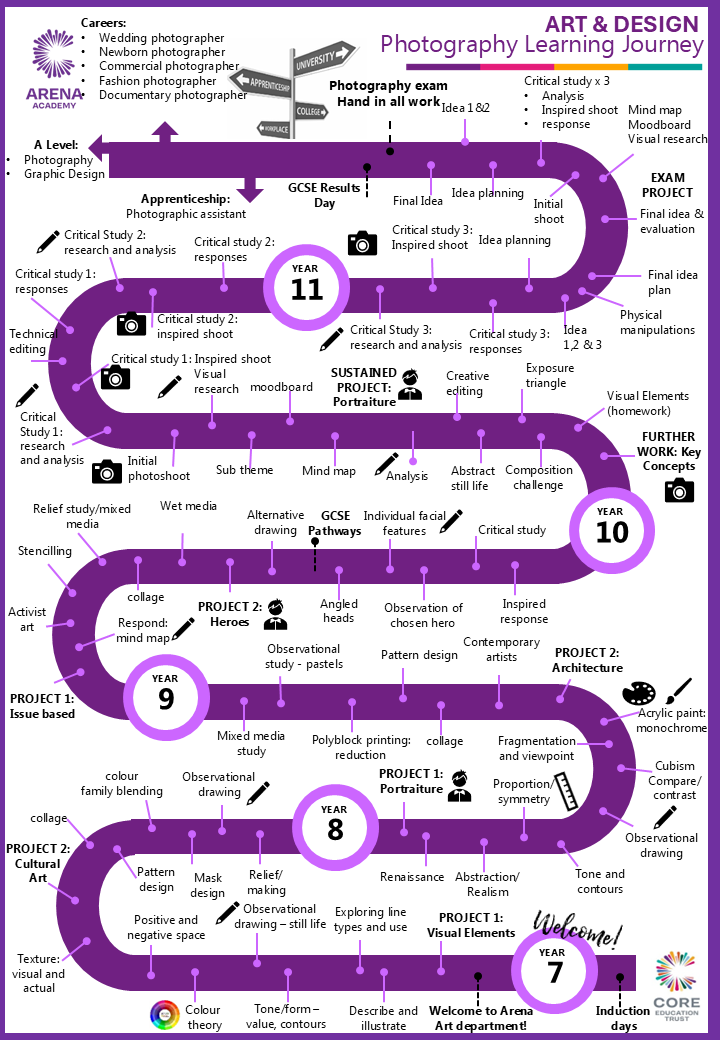
Learning Journey
Assessment and Exams
GCSE Art and Design (Photography) 8206 Specification
Aspire 5
A grade 5 student should be able to:
- Demonstrate a consistent ability to investigate the work of others.
- Create thoughtful analysis that impacts subsequent work.
- Develop a range of ideas inspired by critical research and existing work.
- Demonstrate consistent skill and control in both digital and physical editing techniques.
- Make selections and experiments to refine ideas.
- Evidence a clear creative journey from stimulus to responses.
- Record images with consistently good exposure/lighting, composition and impact.
- Investigate stimulus with a broad range of images.
- Record written annotation using accurate subject terminology.
- Purposefully reflect upon outcomes and process.
- Document the creative process clearly
- Generate responses that are personal, meaningful and fully executed.
- Respond creatively to a project brief.
- Evidence impact of research and creative exploration.